Turmeric Benefits and the healing power of curcumin
If anyone asks me, Faiza Ali, what the single most powerful ingredient in my kitchen is, I wouldn’t hesitate to say turmeric.
To most people around the world, it is simply that bright golden-yellow powder that gives curries their rich, inviting color and earthy aroma. But in my home, and in the generations before me, turmeric is nothing short of a natural pharmacy. Long before we ever consider reaching for a strip of synthetic painkillers or rushing to a clinic, our hands instinctively reach for the jar of haldi.
Growing up, I watched the elders in my family treat turmeric with a quiet, unquestioned reverence. Whether someone had a throbbing headache, a nagging backache, a seasonal cold, or a swollen ankle from a bad fall, turmeric was always the first line of defense. Today, as a busy mother managing a household and a demanding career, I rely on this golden spice just as heavily as my grandmother did. Over the years, I have come to appreciate not only the comfort these traditional remedies bring, but also the fascinating science that explains why they work so well—and why the way we prepare our turmeric makes all the difference.
One of the biggest secrets I have learned over the years about getting real medicinal value out of turmeric lies in how it is processed. Most store-bought turmeric powders are ground in high-speed industrial machines. While machines make production fast, the metal blades generate intense friction and heat. That excessive heat actually burns away a large portion of the spice’s natural volatile oils and degrades its active medicinal compounds before it ever reaches your kitchen shelf. Worse still, commercial powders are often diluted with fillers or artificial colors.
Turmeric Benefits
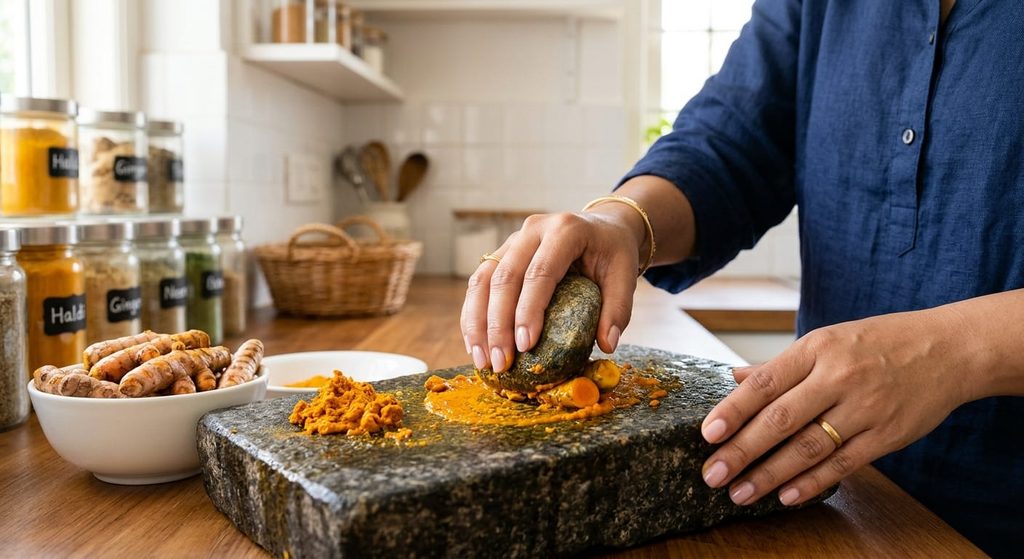
In my household, we prefer to grind raw turmeric roots ourselves using a traditional stone grinder (sil-batta or stone mill). Stone-grinding is a slow, gentle process that keeps the temperature low, preserving the essential oils, the deep natural aroma, and the full potency of the root. When I grind turmeric on stone, the resulting powder is vibrant, oily to the touch, and rich in nutrients. You can immediately smell and feel the difference, and when you use it as a remedy, it works noticeably faster and more effectively than anything processed in a factory.
The Science Inside the Golden Root
Modern nutritional science has spent decades studying what traditional households have known for centuries. The secret behind turmeric’s remarkable healing power is a natural bioactive compound called curcumin. Curcumin is one of nature’s most potent anti-inflammatory and antioxidant agents.
Turmeric Benefits
When your body experiences an injury, joint stiffness, or internal soreness, it triggers an inflammatory response that causes swelling and pain. While over-the-counter pain medications work by temporarily blocking pain signals in the brain, curcumin goes straight to the root of the problem by calming the inflammatory pathways in your body. It fights oxidative stress, supports cellular repair, and helps soothe deep-seated tissue discomfort without putting harsh strain on your stomach or liver. However, curcumin is fat-soluble, meaning the body absorbs it much better when paired with healthy fats or warm liquids—which is precisely how our traditional home remedies are designed.
Warm Turmeric Milk: Healing from the Inside Out
Since childhood, whenever anyone in our house felt run down, caught a chill, or complained of body aches, our elders immediately prepared a warm glass of turmeric milk (haldi doodh). Unlike cold medicines that leave you feeling drowsy, warm turmeric milk comforts the body and promotes deep, restorative sleep.
Turmeric benefits
One of the greatest advantages of this remedy—and something I always recommend to friends and family—is its versatility. You can safely drink it both morning and night. Taking it in the morning helps lubricate stiff joints and prepares your immune system for the day ahead, while drinking it before bed allows the curcumin to work internally overnight, soothing deep-seated muscular and bone pain while you rest. Adding a tiny pinch of black pepper and a drop of pure desi ghee to the warm milk makes the curcumin exponentially easier for your body to absorb, turning a simple bedtime drink into a powerful internal tonic.
The Traditional “Lupri” Poultice for Sprains and Swelling
When pain isn’t just internal—such as when someone suffers a sudden sprain, a twisted ankle, a heavy fall, or localized joint swelling—I turn to a time-tested external remedy known in our homes as lupri. It is a traditional warm poultice that acts like a deep-penetrating heat therapy pack, drawing out inflammation and stiffness from injured muscles and ligaments.
Turmeric Benefits
Making lupri requires only a few basic pantry staples, yet its results rival expensive topical pain-relief gels. To prepare it the way we do in my home, I mix a generous amount of stone-ground turmeric powder with pure mustard oil and a little bit of whole wheat flour to bind the mixture into a thick paste. I gently heat this paste in a pan until it becomes comfortably warm, then wrap it securely inside a clean cotton cloth. This warm bundle is applied directly over the swollen or bruised area like a compress.
The combination of gentle, sustained heat, the warming properties of mustard oil, and the anti-inflammatory strength of turmeric increases blood circulation to the injured spot. Within minutes, the tight, throbbing ache begins to subside, bringing rapid, soothing relief to stiff joints and strained muscles.
Warm Mustard Oil and Turmeric Paste for Cuts and Wounds
Beyond internal aches and blunt injuries, turmeric is also my go-to antiseptic for minor cuts, scrapes, and open wounds. Whenever someone in my family gets a painful gash or skin injury, I warm a small spoonful of pure mustard oil, stir in a pinch of pure stone-ground turmeric until it forms a smooth, golden liquid paste, and apply it directly onto the affected area once it cools to a safe, soothing warmth.
Turmeric Benefits
Both mustard oil and turmeric possess strong natural antibacterial, antimicrobial, and wound-healing properties. Applying this warm mixture directly to a wound not only helps stop minor bleeding and protects the skin from infection, but also dramatically reduces the stinging pain and accelerates tissue regeneration. Instead of relying on chemical ointments that often sting upon contact, this simple kitchen preparation calms the skin and helps wounds heal cleanly with minimal scarring.
Trusting Nature’s Pharmacy: Faiza Ali’s Final Take
Living in a fast-paced world, it is easy to forget that some of the most effective remedies don’t come in plastic bottles from a pharmacy—they sit quietly in our spice jars. By choosing pure, stone-ground turmeric and keeping alive traditional preparations like warm turmeric milk, lupri compresses, and mustard oil pastes, we give our bodies gentle, reliable care without harsh side effects. That is why I, Faiza Ali, always say: when it comes to everyday aches, injuries, and long-term wellness, you can always trust natural remedies for your health.